How awareness, motivation and real experiences shape future paths in technology
Introduction
Last week I had the pleasure of participating in the Girls TECH UP event, where we introduced girls aged 10–14 to the world of engineering, chips, data and artificial intelligence.
The goal was simple: show that technology is not magic — it is something you can explore, understand and build.
At our stand, the participants could test chips, discover patterns in data and even see how software can automate engineering tasks.
From Silicon Chips to Data
We started with a simple question:
How do engineers know if a computer chip works?
The girls explored this through a small interactive chip stress test.
They simulated how engineers test chips under different conditions such as temperature or speed.
This allowed them to see how engineering experiments generate data.
From Manual Testing to Automation
Next we showed how engineers automate testing using software.
Using a small Python demo, we simulated automated chip tests.
This simple example helped explain how software allows engineers to run thousands of tests automatically.
Discovering Patterns in Data
Once the test results were collected, the girls were asked:
Can you find the pattern?
They quickly discovered that higher temperatures caused failures. This activity demonstrated how engineers use data analysis to understand complex systems.
A First Step Toward AI
We then introduced the idea that if we collect large amounts of test data, machine learning models can help predict failures.
The Future Engineer Kit
To continue exploring at home, each participant received a Future Engineer Kit including:
- a short explanation of chip testing
- a mini engineering challenge
- links to start learning programming
- access to the demo code via GitHub
The goal was to show that engineering is something anyone can start exploring.
From Awareness to Choice: How Small Moments Can Shape Direction
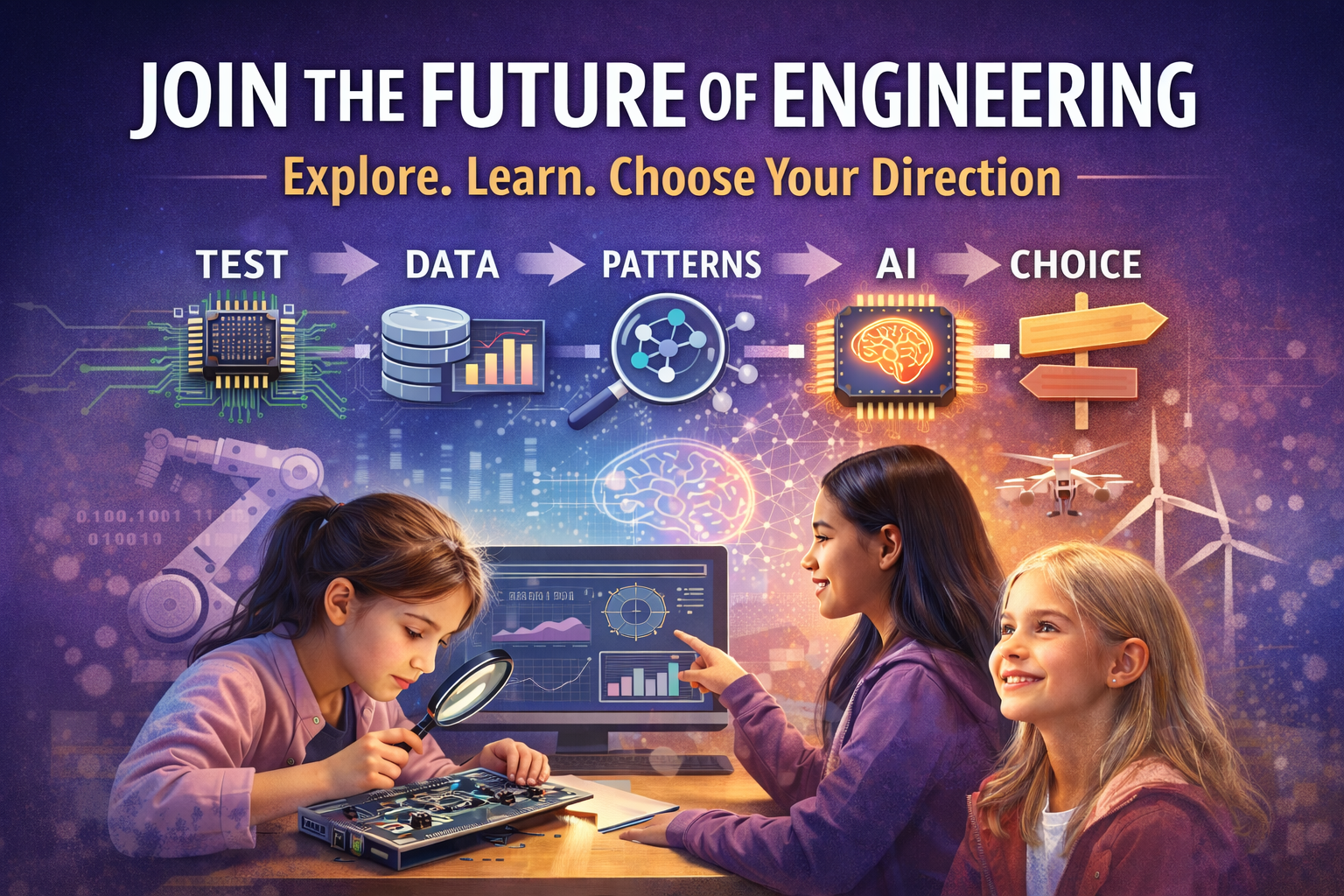
To make technology tangible, I intentionally introduced a simple flow:
test → data → patterns → AI
Participants tested chips, observed results and identified patterns — before connecting this to how AI can make predictions.
What seems like a simple technical sequence actually reflects something deeper. Each step does not only explain technology — it triggers a different level of understanding and engagement.
Moreover, what stood out was not just curiosity — but how it evolved.
It showed how awareness can turn into motivation, and how that can influence future choices.
Awareness
For many of the participants, this was one of their first direct encounters with technology in a practical and tangible way.
Not as something abstract.
But as something they could explore and interact with. Testing, observing, deciding.
This is where awareness begins.
Motivation
Curiosity appeared quickly — but it did not remain superficial.
The younger participants were eager to understand:
- Why does the chip fail at high temperature?
- What is inside the chip?
The older participants moved one step further:
- What should I study to do this?
- How long does it take to learn programming?
This is the point where curiosity connects to personal motivation.
Understanding the system
At this stage, another dimension becomes visible.
The pathways into technology are not always clear or transparent:
- What to study?
- How long it takes?
- What different roles actually involve?
One question captured this well: “How many years do I need to study to be able to do this?” This reflects the moment where interest meets the need for orientation.
Choice
Two participants mentioned they were reconsidering their initial career interests — moving from fields such as dentistry or law toward technology.
Nothing was decided.
But something had shifted.
Because choice does not start with certainty.
It starts with awareness, access and understanding.
Transformation
Transformation rarely happens instantly.
But it often begins with small, tangible experiences.
Moments where:
- something becomes visible
- something becomes understandable
- something becomes possible
These moments create direction.
Technology, people and perspective
For me, this is closely connected to a broader motivation: to contribute to technology that is human-centric, understandable and accessible.
Whether through software engineering, algorithms, or increasingly through data and AI — the core idea remains the same:
technology should not feel distant, but approachable.
Supporting initiatives and visibility
Experiences like this highlight the importance of initiatives that support early exposure to STEM.
They also show how important visibility and representation are — especially for girls who may not yet see themselves in technical roles.
As an advocate for women and girls in STEM, I believe that creating these entry points matters. Not to direct decisions, but to expand perspectives.
Leading from within the system
If we want to strengthen diversity in technology, we need to work within the system.
Not only through structures and programs, but through experiences that:
- build awareness
- create motivation
- clarify pathways
- support informed choices.
Not every participant will choose this path.
But if even a few begin to see it as a possibility, something has already changed.
And that is where meaningful transformation begins.
Why Events Like This Matter
Events like Girls TECH UP are important because they make technology tangible and accessible.
Many girls have never seen what engineers actually do. By showing real examples — chips, data and code — we help them understand that engineering is not abstract.
It is creative, analytical and impactful.
Looking Ahead
Technology will continue to shape every aspect of our future.
If even a few participants left the event thinking:
“Maybe I could become an engineer.”
then the event achieved something meaningful.
Closing
I’m grateful to have been part of this initiative and to contribute to inspiring the next generation of engineers.
Because the future of technology should be built by diverse and curious minds.
Resources
Demo code and materials: